
Concrete Maintenance Guide for Canyon Lake Homeowners
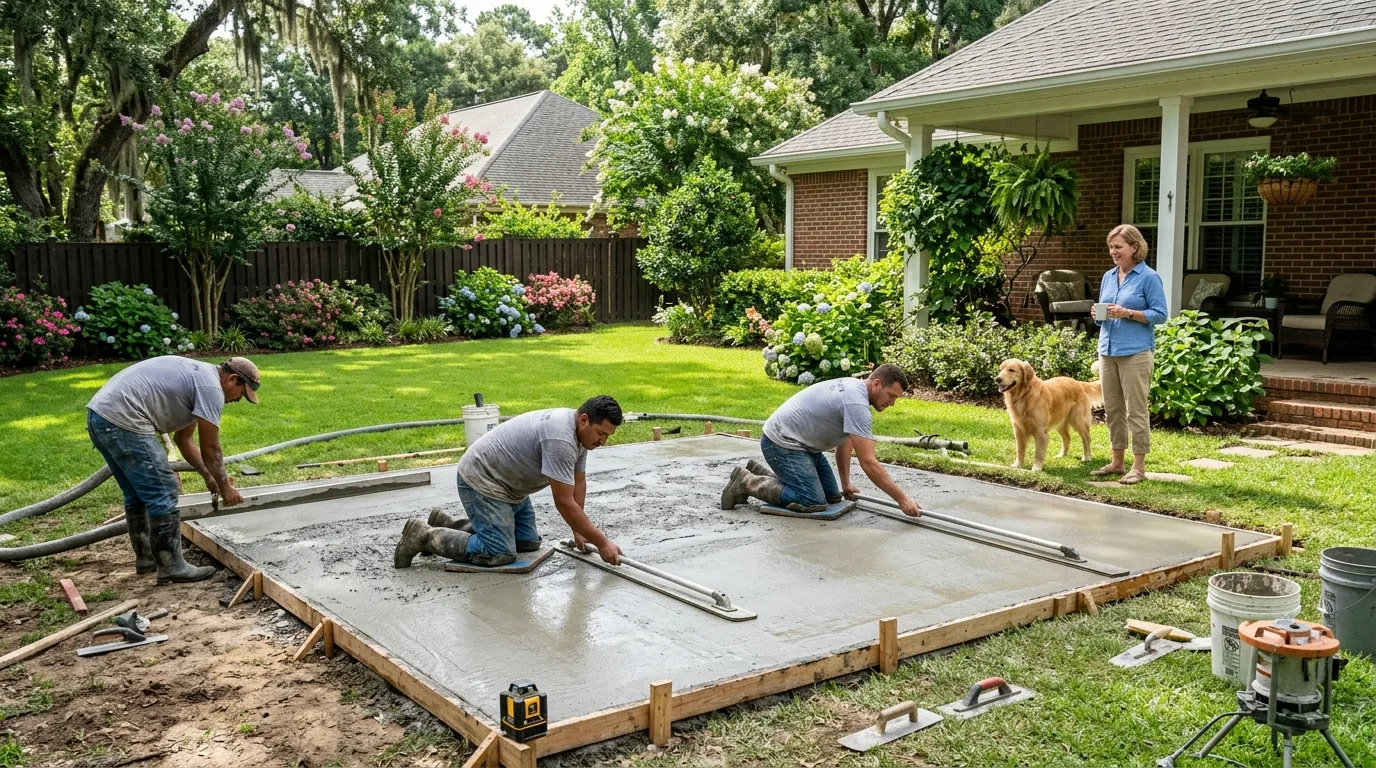
Concrete in Canyon Lake faces a specific set of maintenance challenges that homeowners from other Texas regions may not have dealt with: expansive clay soil that shrinks and swells seasonally beneath slabs, 94°F August temperatures that accelerate surface UV degradation, heavy Hill Country rainstorms that saturate the subgrade, and Canyon Lake POA requirements that can trigger compliance notices for visibly deteriorated surfaces. This maintenance guide covers the practical schedule and specific actions Canyon Lake homeowners need to extend the life of their concrete.
Professional Concrete Assessment in Canyon Lake
Canyon Lake Concrete Pros provides free assessments for driveways, patios, and slabs throughout Comal County — call (888) 376-0955.
Why Standard Concrete Maintenance Advice Doesn’t Fully Apply in Canyon Lake
Most concrete maintenance guides assume relatively stable soil conditions and moderate climate. Canyon Lake’s combination of expansive clay soil and Texas heat creates conditions where maintenance timing and product selection matter more than they do in other markets.
The clay soil factor: Comal County’s clay soil expands when wet and contracts when dry — a cycle that repeats across Canyon Lake’s distinct wet spring (avg 4.20–4.30” rainfall in May) and dry late summer. Concrete slabs that sit on this soil move slightly with each cycle. Well-maintained concrete with proper joint sealants rides out these cycles gracefully. Concrete with open cracks or joints allows water to infiltrate the clay, which amplifies the moisture cycle and accelerates movement.
The UV and heat factor: Canyon Lake averages 300+ sunny days annually with August highs of 94°F. Unsealed concrete surfaces exposed to this UV intensity show surface scaling and color degradation within 5–8 years. In the Texas Hill Country context, sealing isn’t optional maintenance — it’s the primary factor separating 40-year driveways from 15-year ones.
The Canyon Lake Concrete Maintenance Calendar
Year 1 (New Concrete): The Foundation of Long Life
Days 0–28: Curing period. Avoid vehicle traffic for at least 7 days; avoid heavy vehicles for 28 days. Keep the surface moist during the first week if temperatures exceed 90°F during placement — this prevents surface checking from rapid moisture loss. Do not apply any sealers or coatings during this period.
Day 30–90: First sealer application. Once curing is complete, apply a penetrating silane-siloxane sealer appropriate for exterior concrete in Texas UV conditions. Penetrating sealers (as opposed to topical/film-forming sealers) don’t change the surface appearance and provide long-lasting protection without the peeling that film sealers develop in Canyon Lake’s heat. For stamped concrete, use a topical sealer recommended by the stamping contractor to restore and protect the color.
Month 3–6: First joint inspection. Walk the slab and inspect all control joints (the saw-cut or tooled lines in the concrete). These are designed weak points where any movement-related cracking occurs in a controlled location. Check that joint sealant is intact and not open to water infiltration.
Years 2–5: Routine Monitoring Phase
Annual spring inspection (April–May): After Canyon Lake’s wet spring, inspect the entire concrete surface for:
- New cracks that weren’t present last year
- Changes in crack width (opening is significant; cracks that have always been tight are less urgent)
- Differential settlement — sections sitting at different heights
- Drainage pattern changes — water pooling where it didn’t before
- Surface scaling or spalling — concrete flaking at the surface level
- Joint sealant condition — cracked, open, or missing sections
Annual fall inspection (October–November): After Canyon Lake’s hot, dry late summer, repeat the inspection. This is when clay soil is at minimum moisture content and slabs may show maximum settlement. Cracks that appeared small in the spring may have opened through the summer.
Crack treatment: Small surface cracks under 1/8” wide that haven’t changed year-to-year are typically dormant and can be treated with a polymer-modified crack filler available at hardware stores. Apply according to label directions, feather flush with the surface, and seal over. Cracks wider than 1/4”, cracks that are actively growing, and any crack associated with differential settlement (one side higher than the other) warrant a professional assessment. See our concrete repair service page for the evaluation process.
Year 3–5: Resealing Phase
Penetrating sealer reapplication every 3–5 years: On Canyon Lake’s UV exposure, most penetrating sealers need reapplication at the 3–5 year mark. Test your slab by pouring a tablespoon of water on the surface: if it beads up, the sealer is still active. If it soaks in within 30–60 seconds, the sealer has depleted and reapplication is due.
Stamped concrete: 2–3 year resealing schedule. Stamped concrete patios and driveways in Canyon Lake need their topical sealer refreshed more frequently than plain concrete — the clear coat that protects both the color and the texture pattern degrades faster than a penetrating sealer on plain gray. Use a UV-resistant, water-based acrylic or polyurethane sealer specified for exterior stamped concrete in hot climates.
Year 5+: Structural Evaluation Phase
By year 5, most Canyon Lake concrete surfaces have accumulated enough service history to assess their long-term trajectory. A professional concrete assessment at this point helps determine:
- Whether minor crack repair is still the right strategy or full panel replacement is approaching
- Whether any areas show differential settlement that requires mudjacking or void filling
- Whether the slab is draining properly given any landscaping or grade changes since installation
This is also the right time to evaluate whether any sections have developed drainage patterns that are directing water toward the house foundation — a problem that affects some Canyon Lake properties as clay soil settles unevenly over time.
Cleaning Concrete in Canyon Lake
Standard cleaning: Periodic cleaning of Canyon Lake concrete removes organic material (mold, mildew from humidity), mineral deposits from hard water, and the red clay dust that coats surfaces after dry spells. A pressure washer at 1,500–2,500 PSI with a wide fan tip (25–40 degree nozzle) is appropriate for sealed concrete driveways and patios. Avoid sustained pressure in one spot on older concrete that may have a weakened surface layer.
Mold and mildew: Canyon Lake’s humidity, especially in shaded areas near the lake or under trees, creates conditions for mold and mildew growth on concrete. A 1:4 dilution of bleach and water, applied with a stiff brush and rinsed thoroughly, addresses most mold growth. Commercial concrete cleaners with sodium hypochlorite are also effective. Treat annually if mold recurs in the same location — recurrence usually indicates inadequate drainage or shade that keeps the surface wet.
Oil and grease stains: Driveway oil stains common in Canyon Lake garages and carports respond to degreaser products, cat litter absorption, or specific concrete stain removers. Apply promptly — the longer an oil stain sits, the deeper it penetrates and the harder it is to fully remove.
Rust stains: Canyon Lake well water with high iron content, or metal furniture left on concrete, can create orange-brown rust stains. These are cosmetic, not structural, and respond to oxalic acid-based cleaners. Do not use muriatic acid on sealed concrete — it damages both the sealer and the concrete surface.
POA Compliance and Concrete Maintenance
Canyon Lake POA members should be aware that visibly deteriorated concrete — significant spalling, large surface area cracking, broken curbing — can trigger ACC compliance notices under the community’s property maintenance standards. The practical implication:
- Concrete with cosmetic issues (minor cracks, slight color fading) generally does not attract compliance attention.
- Concrete with structural deterioration visible from the street — sections that have broken off, significant displacement between sections, or safety hazards — is more likely to be flagged.
- POA members who receive a compliance notice about concrete should respond with a contractor engagement letter or timeline for repair. Most POA boards are reasonable about repair timelines when a homeowner demonstrates good-faith intent to address the issue.
When to Call a Professional vs. DIY
DIY appropriate:
- Crack filler application on dormant cracks under 1/8”
- Sealer application (proper surface prep is key — clean, dry, and deglossed if it’s a reapplication over old topical sealer)
- Routine cleaning
- Joint sealant replacement in control joints that are in good condition otherwise
Call a professional:
- Any crack wider than 1/4” or growing year-to-year
- Any differential settlement between slab sections
- Surface spalling or scaling that covers more than 15–20% of a section
- Drainage changes that suggest subgrade movement
- Cracks in post-tension slabs (these require different repair approaches than conventional concrete)
- Any situation where the structural integrity of the slab is in question
Frequently Asked Questions
How often should I seal my Canyon Lake concrete driveway?
Penetrating sealer: every 3–5 years — use the water-bead test to confirm when reapplication is due. Topical/film sealer on stamped concrete: every 2–3 years in Canyon Lake’s UV environment. The cost of staying on schedule ($150–$350 per sealing for a typical Canyon Lake driveway) is a fraction of premature replacement cost. See our driveway longevity guide for more on how sealing affects how long your concrete lasts.
My Canyon Lake driveway has a crack that opens and closes with the seasons. Is that normal?
On Comal County’s expansive clay, minor seasonal crack movement (under 1/16” total change) is expected and is not necessarily a sign of structural failure. The concern arises when: the crack is actively widening over multiple seasons, one side of the crack is higher than the other, or the crack is associated with other symptoms like drainage changes. Have a professional evaluate any crack that has changed more than 1/8” over two or more seasonal cycles. Our concrete repair service covers the full evaluation and repair process.
Can I power-wash my Canyon Lake concrete patio without damaging it?
Yes, with appropriate technique. Use 1,500–2,500 PSI with a fan nozzle (25–40 degree tip, not a zero-degree pencil jet). Keep the nozzle 8–12 inches from the surface and maintain even, sweeping motion. Avoid sustained pressure in one spot, especially on older concrete with surface scaling. After power-washing a topically sealed surface, inspect whether the sealer needs refreshing — aggressive cleaning can remove or thin a worn topical sealer.
Concrete Maintenance and Repair in Canyon Lake TX
Canyon Lake Concrete Pros provides assessments, sealing, crack repair, and full replacement services throughout Comal County — call (888) 376-0955.
Related: