
Concrete vs. Asphalt Driveway: Which is Better in Canyon Lake TX?
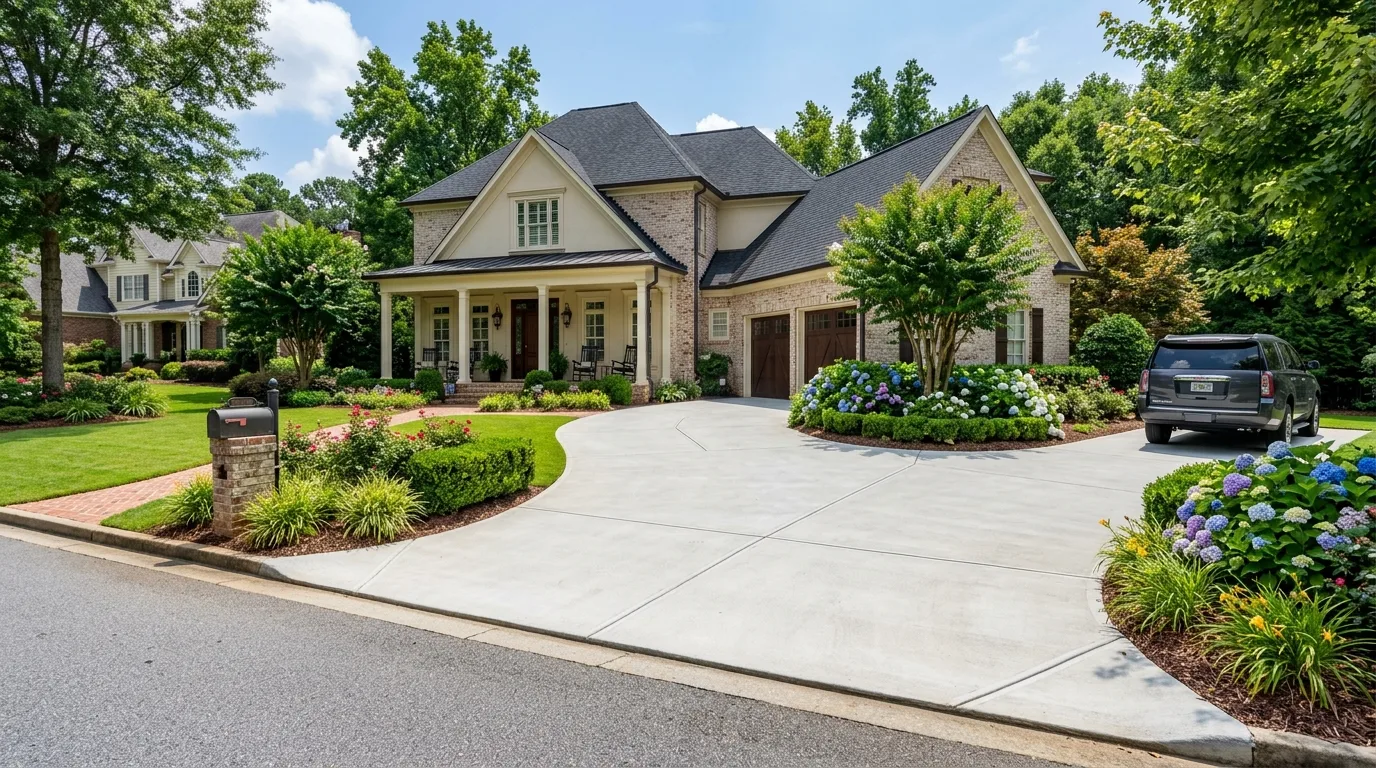
Most Canyon Lake homeowners considering a new driveway ask the same question: concrete or asphalt? The answer in most Texas markets is concrete — but Canyon Lake has specific soil and climate conditions that make the comparison worth examining in detail. This guide covers how each material performs on Comal County’s expansive clay, in Texas summer heat, and over a 20–30 year ownership period so you can make the right choice for your property.
Get a Free Driveway Estimate in Canyon Lake
Canyon Lake Concrete Pros installs concrete driveways throughout Comal County — call (888) 376-0955 for a free site assessment.
Why Canyon Lake’s Climate Makes Asphalt a Harder Sell
Asphalt is a petroleum-based material that softens at high temperatures. In the Texas Hill Country, where August high temperatures in Canyon Lake average 94°F and sun-exposed pavement surfaces can reach 160°F+, asphalt driveways soften visibly during summer. The surface becomes tacky, vehicles can leave tire marks, and heavy vehicles (delivery trucks, RVs common in Canyon Lake’s recreation culture) can leave permanent impressions in soft asphalt during summer months.
Concrete, by contrast, gains strength with heat and does not soften. A properly installed concrete driveway maintains its structural integrity regardless of summer temperatures in Canyon Lake. This difference alone is a major factor in the Canyon Lake market — and it’s why concrete represents a much larger share of new driveways here than in northern climates where asphalt performs more comparably to concrete.
Clay Soil: How Each Material Responds
Comal County’s expansive clay is the other defining variable for Canyon Lake driveways. This soil swells when wet from Canyon Lake’s 37.44” of annual precipitation and contracts during dry periods. The vertical movement — sometimes an inch or more across a season in neighborhoods like Mystic Shores and Canyon Lake Hills — exerts stress on any paved surface.
Asphalt on Canyon Lake clay: Asphalt’s flexibility is often cited as an advantage on moving soil — it can flex without cracking the way rigid concrete does. However, in canyon Lake’s heat, this flexibility works against the material during summer, when the soil movement combines with thermal softening to cause rutting and deformation. Asphalt repairs on expansive clay are frequent and cumulative — each repair cycle adds cost.
Concrete on Canyon Lake clay: Concrete requires proper base prep (crushed limestone layer, compacted subgrade) and adequate thickness (5–6”) with rebar reinforcement to perform well on expansive clay. Done correctly, it resists the soil movement through structural rigidity and properly spaced control joints that direct cracking to planned locations rather than across the slab face. Done incorrectly (4” slab without base prep), concrete on Canyon Lake’s clay will crack in 5–10 years.
The conclusion: concrete on Comal County’s clay requires more upfront investment in base preparation. Asphalt avoids some of the rigid-slab cracking risk but brings Texas heat performance problems that are arguably more damaging to daily usability.
Types of Driveway Surfaces to Consider
Standard broom-finish concrete: The most economical concrete option. Rough texture provides good traction in all weather conditions — particularly relevant for Canyon Lake’s steep hillside driveways. Cost: $7–$10/sqft installed.
Exposed aggregate concrete: Smooth pebbles embedded in the surface, cooler underfoot than standard concrete and excellent traction when wet. Suitable for Canyon Lake properties where bare feet are common (lakefront homes). Cost: $9–$12/sqft.
Stamped concrete: Decorative patterns in stone, brick, or slate — highest visual impact. Requires re-sealing every 2–3 years in Canyon Lake’s UV environment. Cost: $10–$21/sqft depending on complexity.
Standard asphalt: Lower upfront cost, but requires seal coating every 1–3 years, softens in summer heat, and typically lasts 15–20 years vs. 30–50 for concrete in this climate. Cost: $3–$5/sqft installed.
Chip seal: A hybrid option that uses a layer of liquid asphalt with aggregate pressed in. Less prone to softening than standard asphalt, lower cost than concrete, but rougher surface texture. Occasionally used on rural Canyon Lake properties and larger lots near Sattler and Startzville.
How Concrete and Asphalt Work Over Time
A Canyon Lake homeowner who installs standard asphalt will typically spend on: initial installation ($3–$5/sqft), seal coating every 2 years (~$0.20–$0.40/sqft per application), crack filling as needed, and full replacement after 15–20 years. Total 30-year cost on a 600 sq ft driveway: approximately $8,000–$12,000.
The same homeowner installing concrete will spend on: initial installation ($7–$10/sqft), periodic sealing every 5 years (~$0.30–$0.50/sqft per application), minor crack repair if needed, and potentially no replacement within 30 years if properly built. Total 30-year cost on a 600 sq ft driveway: approximately $5,500–$8,500.
The upfront cost difference between asphalt and concrete (~$2,400–$3,000 for 600 sq ft) narrows significantly when lifecycle costs and the replacement cycle of asphalt are factored in. In Canyon Lake’s heat environment, the gap closes further because asphalt maintenance cycles are shorter than in cooler climates.
Practical Uses for This Comparison
- POA communities: Many Canyon Lake POA neighborhoods specify or prefer concrete over asphalt. Check your ACC guidelines before selecting a material.
- Resale value: In the Canyon Lake real estate market, concrete driveways are associated with higher-end properties and contribute more to perceived value than asphalt.
- Rural properties: Larger lots near Startzville and Sattler sometimes use asphalt or chip seal for long approach drives where total cost is a major factor. Concrete is typically reserved for the garage pad and immediate approach.
- Lakefront properties: Concrete is the clear winner for waterfront properties where UV exposure, heavy summer use, and property aesthetics all point toward concrete.
Frequently Asked Questions
Is concrete more expensive than asphalt in Canyon Lake?
Yes — concrete typically costs $7–$10/sqft vs. $3–$5/sqft for asphalt in Canyon Lake. However, the 30-year lifecycle cost of concrete is often lower when asphalt’s more frequent seal coating and shorter replacement cycle are factored in. In Canyon Lake’s heat, asphalt maintenance cycles are shorter than national averages.
Does asphalt work at all in Canyon Lake’s summer heat?
Asphalt functions in Canyon Lake’s summers, but it softens noticeably and vehicle tire marks and heavy vehicle impressions are common. Newer polymer-modified asphalt mixes improve heat resistance, but standard asphalt remains significantly more heat-sensitive than concrete at Canyon Lake’s typical summer temperatures.
Can I convert asphalt to concrete in Canyon Lake?
Yes — asphalt-to-concrete conversion is one of the more common driveway projects we handle in Canyon Lake. The existing asphalt is demolished and hauled, the subgrade is reassessed and prepared, and a new concrete driveway is installed. See our full service page on concrete driveway contractors in Canyon Lake and our post on signs your Canyon Lake driveway needs replacing for more context.
Concrete Driveway Installation in Canyon Lake, TX
Ready to upgrade from asphalt? Canyon Lake Concrete Pros provides free estimates and handles the full demolition and installation process.
Related: