
Concrete vs. Pavers: Which is Better for Canyon Lake TX Homes?
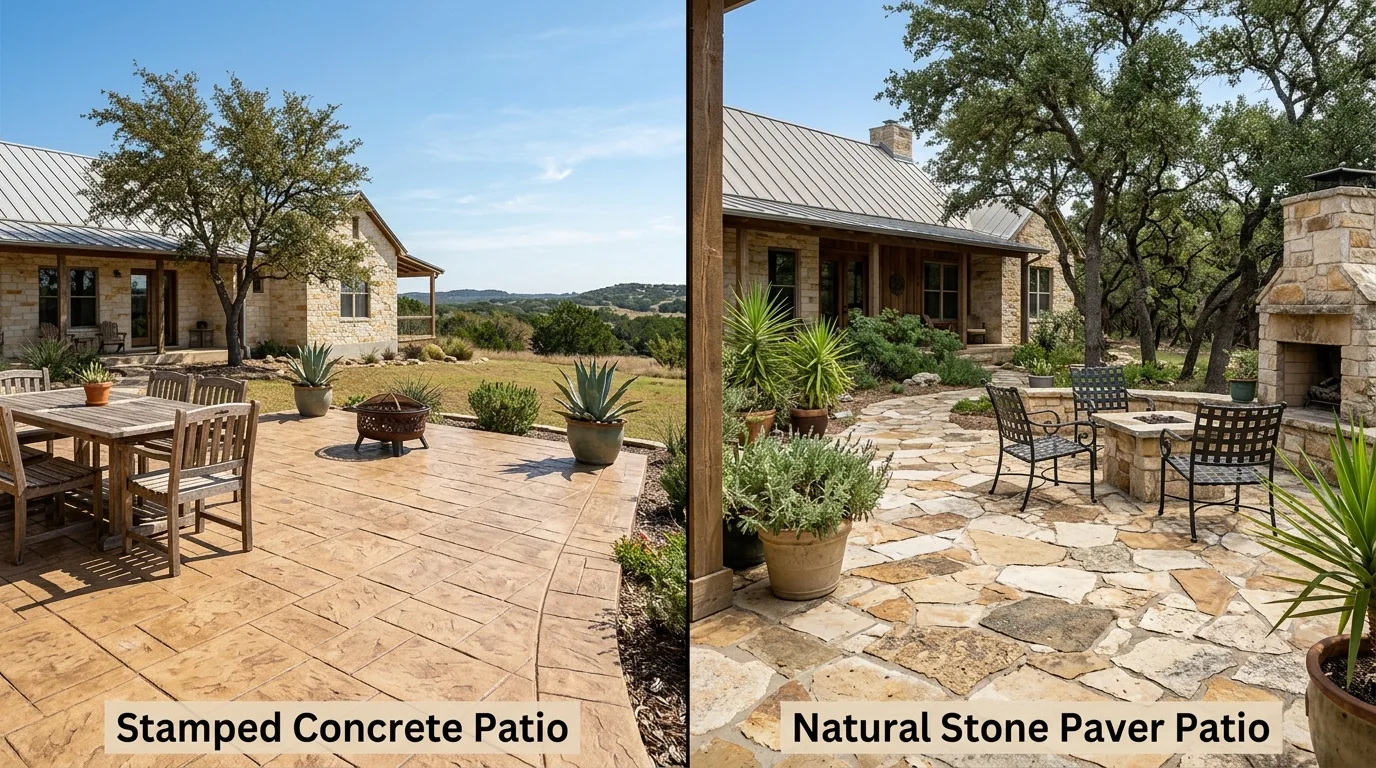
The concrete-vs.-pavers debate comes up in almost every Canyon Lake patio and driveway conversation. Pavers look beautiful in photos and offer design flexibility that poured concrete can’t match. But on Comal County’s expansive clay soil — the same soil that shifts beneath every foundation in Mystic Shores and Canyon Lake Hills — pavers have a fundamental structural weakness that accelerates maintenance costs and often leads homeowners back to concrete within a decade. This guide gives Canyon Lake homeowners the full comparison.
Get a Canyon Lake Patio Estimate
Canyon Lake Concrete Pros helps homeowners choose the right material for their specific site and goals — call (888) 376-0955 for a free consultation.
The Core Difference: How Each Material Handles Soil Movement
Both concrete and pavers sit on the same Comal County clay soil, but they respond to that soil’s seasonal movement in fundamentally different ways.
Concrete is a monolithic slab — when it moves, it moves as one unit. Properly designed concrete with control joints and rebar reinforcement can handle significant clay soil movement while maintaining a usable, level surface. When movement does cause a crack, it typically appears at a control joint (a planned location) rather than randomly across the surface. The slab remains navigable; the joint can be filled and monitored.
Pavers are individual units set in a sand or gravel bed. Their design advantage — the ability to flex between units — is also their main weakness on expansive clay. As the clay beneath Canyon Lake patios swells and contracts, individual pavers shift independently. Over 3–5 years on active clay soil, a paver patio or driveway that started perfectly flat will develop waves, sunken areas, and raised edges that create trip hazards and require periodic re-leveling.
The key insight for Canyon Lake: the same soil flexibility that makes pavers perform better than rigid concrete in some soil conditions makes them worse on expansive clay, where the soil moves more and less predictably than sandy or stable soils.
Maintenance Reality on Canyon Lake’s Clay
The maintenance comparison between concrete and pavers is where Comal County’s specific conditions produce the most significant real-world differences.
Concrete maintenance in Canyon Lake: Re-sealing every 3–5 years for plain concrete, 2–3 years for stamped concrete. Crack filling as needed (typically minor on a properly built slab). Occasional joint re-filling for control joints. Total annual maintenance cost for a 300 sq ft concrete patio: approximately $50–$150 averaged across years.
Paver maintenance in Canyon Lake: Weed control in joints (clay soil plus organic material in paver joints is ideal weed habitat), re-leveling of sunken or raised sections every 2–5 years (typically requires lifting, regrading, and re-setting), joint sand replenishment after every significant rain, cleaning and sealing every 1–3 years. In active clay areas like Ensenada Shores, homeowners may need professional re-leveling every 3–4 years at $500–$2,000 per visit. Total annual maintenance cost for a 300 sq ft paver patio: $200–$500 averaged across years.
The paver maintenance calculus changes significantly if the pavers are set on a concrete base rather than a sand bed — this reduces the shifting problem substantially but also eliminates the primary cost advantage of pavers.
Types of Surfaces to Compare
Plain concrete vs. standard pavers: Concrete wins on Canyon Lake clay for maintenance, longevity, and structural stability. Standard pavers have a slight advantage in individual unit replaceability — one cracked paver can be swapped; a cracked concrete panel requires patching.
Stamped concrete vs. premium pavers: This is the closer comparison. Premium pavers (natural stone, high-end concrete units) cost $15–$30/sqft installed and offer unique visual variety. Stamped concrete costs $10–$21/sqft and can replicate stone and brick convincingly. Both require sealing maintenance. On Canyon Lake’s clay, stamped concrete maintains its levelness over time; premium pavers shift. Over a 10-year period, stamped concrete typically requires less total investment on Comal County terrain.
Exposed aggregate concrete vs. tumbled pavers: Both provide a natural, textured aesthetic popular in Canyon Lake’s Hill Country context. Similar visual quality; concrete maintains structural advantage on clay soil.
Cost Comparison for Canyon Lake Properties
For a typical 300 sq ft patio in Canyon Lake:
Plain concrete: $900–$1,200 installed. No demo of existing material assumed.
Stamped concrete: $3,000–$6,300 installed.
Standard concrete pavers (set on sand): $2,400–$4,500 installed.
Premium stone or brick pavers: $4,500–$9,000 installed.
Concrete pavers on concrete base: $3,000–$6,000 installed — more expensive than pavers on sand, closer to stamped concrete territory, but with reduced shifting risk.
When lifecycle costs are added — 10-year maintenance estimates — the gap between stamped concrete and premium pavers on Canyon Lake’s clay narrows or eliminates, and concrete typically comes out ahead.
When Pavers Are the Right Choice in Canyon Lake
Pavers have genuine advantages in specific Canyon Lake applications:
- Small accent areas with stable soil: Entry accent pads, fire pit surrounds on bedrock-close lots where clay depth is minimal — the shifting problem is reduced when limestone is close to the surface.
- Permeable paving requirements: In floodplain-adjacent Canyon Lake lots where impervious cover restrictions apply, permeable pavers allow stormwater to infiltrate. Concrete does not.
- Easy utility access: Pavers over buried utilities can be lifted and reset without breaking and repuring concrete. For areas with frequent utility access needs, this is a real advantage.
- Partial replacement preference: If you strongly prefer the ability to replace individual units when damage occurs, pavers offer that option. It’s a minor factor for most homeowners but worth noting.
Practical Uses for This Comparison
- Pool deck decision: For Canyon Lake pool decks where barefoot use is constant and drainage is critical, concrete wins decisively over pavers. See our pool deck guide for the full analysis.
- POA compliance: Some Canyon Lake POA subdivisions specify or restrict paver use. Check your deed restrictions before selecting a material.
- Resale positioning: In Canyon Lake’s real estate market, stamped concrete patios and driveways photograph well and are considered a premium feature. Pavers are also valued, but the maintenance concern is a real buyer objection on clay-soil properties.
Frequently Asked Questions
Can pavers be set on a concrete base to reduce shifting in Canyon Lake?
Yes — and this is the approach we recommend when a homeowner is committed to pavers on Comal County clay. Setting pavers in a mortar bed over a reinforced concrete slab eliminates most of the shifting problem. The cost increases to $3,000–$6,000 for 300 sq ft, putting it in stamped concrete territory. The trade-off is worth it if the specific paver aesthetic is important.
How long do pavers last in Canyon Lake’s climate?
Pavers themselves — the individual units — are very durable and can last 30+ years. The installation, meaning the leveled surface, requires maintenance every 3–5 years on Canyon Lake’s clay. See our related post on stamped concrete patios in Canyon Lake for how the two options compare in practice.
Which material adds more value to a Canyon Lake home?
In the current Canyon Lake real estate market, both materials add value when well-executed. Stamped concrete patios tend to photograph better and require less buyer education about maintenance. Premium stone pavers add distinctive character that appeals to specific buyers. The maintenance concern around pavers on expansive clay is a real objection that informed buyers raise.
Canyon Lake Concrete That Outperforms Pavers on Clay Soil
Call Canyon Lake Concrete Pros at (888) 376-0955 — free estimates for patios, driveways, and pool decks throughout Comal County.
Related: