
Canyon Lake Driveway Replacement: 5 Signs It's Time
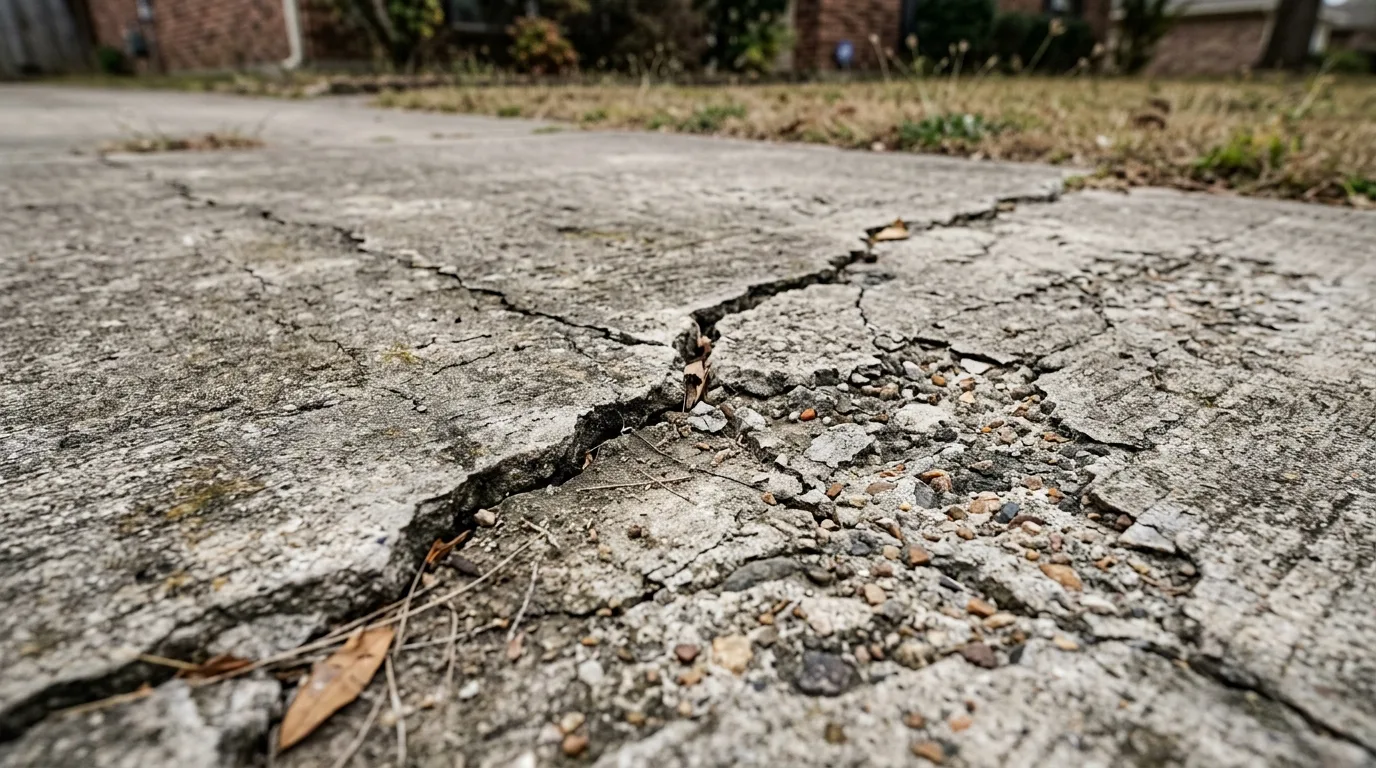
Most Canyon Lake homeowners wait too long to replace a failing driveway — then discover the repair window has closed and a full replacement is the only viable option. Knowing the difference between a driveway that can still be repaired and one that needs to come out saves thousands of dollars and years of frustration. Here are the five clearest signs that your Canyon Lake concrete or asphalt driveway has crossed the threshold from repair into replacement territory.
Free Driveway Assessment in Canyon Lake
Canyon Lake Concrete Pros gives honest repair vs. replacement assessments — no sales pressure, just a straight evaluation. Call (888) 376-0955.
Why Canyon Lake Driveways Fail Earlier Than Expected
Comal County’s expansive clay soil is the primary reason driveways in Canyon Lake fail earlier than the national average. This clay absorbs moisture from the area’s 37.44” of annual precipitation and swells upward, then contracts during dry spells — creating a seasonal push-pull cycle beneath every driveway in Canyon Lake Hills, Mystic Shores, Ensenada Shores, and the broader Hill Country. Driveways installed without adequate base preparation or rebar reinforcement don’t have the structural integrity to resist this soil movement, and they show it within 5–10 years.
The heat compounds the problem. Canyon Lake’s August highs average 94°F, which accelerates thermal expansion cycles that stress concrete joints and cause asphalt to soften and rut. A driveway that was borderline adequate for a cooler market often fails well ahead of schedule in this climate.
Sign 1: Multiple Interconnected Cracks
A single crack — even a wide one — may be repairable. A network of interconnected cracks is a different story. When cracks form a grid, spiderweb, or alligator pattern across a section of driveway, the base beneath that section has failed. The sub-base has either settled, been undermined by moisture from Canyon Lake’s rain events, or been lifted by clay soil swelling. In any of these cases, filling the surface cracks does nothing to address the root cause — the base will continue moving and the filled cracks will reopen, often within one rainy season.
What to look for: Multiple cracks in the same section that follow irregular paths and seem to connect to each other, rather than single clean linear cracks that run perpendicular to the driveway direction.
Sign 2: Sections That Are Higher or Lower Than Adjacent Panels
Differential settlement — where one slab section sinks or rises relative to adjacent panels — is a structural failure in the base or subgrade beneath the driveway. On Canyon Lake’s clay soil, this happens when moisture levels are uneven beneath the slab. A section near a downspout that gets more water than adjacent sections will have wetter clay beneath it, which swells more and lifts that section. A section near a tree with deep roots that draws moisture from the soil will have drier, contracted clay beneath it, causing settlement.
Edge-lifting on corner sections (where the corner rises above the rest of the slab) is particularly common in Comal County. This is one of the most recognizable failure signatures of concrete on expansive clay without adequate reinforcement.
What to look for: Any section where the concrete surface is more than 1/2” higher or lower than the adjacent section at a joint. Trip hazards at driveway panel joints are a clear indicator that differential movement has occurred.
Sign 3: Crumbling Edges and Surface Spalling Over Large Areas
Concrete edges and surface crumbling (called spalling) in isolated spots can be repaired with patching mortar. When spalling covers more than 30–40% of the driveway surface, the cost of patching approaches replacement cost, and the underlying cause — usually a combination of UV degradation from Canyon Lake’s sun and freeze-thaw stress at the surface — means the repair will continue failing across additional sections.
Asphalt driveways that have developed widespread crumbling and cracking, where the aggregate is exposed across most of the surface, are also past the repair point. Seal coating over this damage provides temporary appearance improvement but doesn’t rebuild the structural integrity.
What to look for: Large areas where the surface texture is rough and pitted, where chunks of material are breaking loose, or where the top layer of concrete is peeling away in thin sheets. Compare the affected area to the total driveway surface — anything above 40% in poor condition tilts the math toward replacement.
Sign 4: Drainage Has Failed and Water Reaches the Foundation
A concrete driveway that was originally sloped to drain water away from the garage and house can develop drainage reversal over time as sections settle unevenly on Canyon Lake’s clay. When a section settles toward the house or a joint opens and creates a low point, water begins routing toward the foundation instead of away from it. This is both a driveway problem and a foundation risk — saturated soil at the foundation perimeter is exactly what drives the foundation movement described in our Comal County foundation repair guide.
Once drainage failure is severe enough to create standing water near the garage door or foundation wall, the driveway is actively contributing to a larger problem. This is a sign that replacement — with corrected drainage grades — is the right investment.
What to look for: Water pooling near the garage door, visible waterline staining on the garage floor near the threshold, or any area of the driveway that holds water rather than draining within an hour of rain.
Sign 5: The Driveway Is More Than 25 Years Old and Showing Multiple Issues
Age alone doesn’t require replacement — a well-built Canyon Lake concrete driveway can last 40+ years with proper maintenance. But a driveway that is 25+ years old and showing two or more of the above signs has likely reached the end of its effective service life. At this point, the repair-to-replacement cost ratio no longer favors repair: each individual repair is extending a failing asset rather than solving the underlying structural issues.
This is particularly true for driveways in Canyon Lake neighborhoods that were originally built in the 1990s and early 2000s, before current slab thickness and rebar reinforcement standards were widely adopted in the Hill Country market.
Practical Uses for This Guide
- Before listing a home: If you’re preparing a Canyon Lake property for sale, having a professional assess the driveway condition before listing prevents buyer inspection surprises. A fresh concrete driveway is one of the highest-ROI improvements in the Hill Country market.
- After a wet season: Fall — after Canyon Lake’s heavy spring and summer rains — is the best time to assess driveway damage. The clay soil has gone through a full swell-and-contract cycle, and any structurally weak sections will have shown their issues.
- POA compliance: Canyon Lake POA members with visible driveway deterioration may receive ACC notices to repair or replace. Having a professional assessment helps you respond with an appropriate scope of work.
Frequently Asked Questions
How much does driveway replacement cost in Canyon Lake?
A full concrete driveway replacement in Canyon Lake runs $7–$10 per square foot for standard broom-finish work, including demo and haul of the existing surface. A 600 sq ft two-car driveway costs $4,200–$6,000 for plain concrete. See our full breakdown in the Canyon Lake concrete driveway cost guide.
Can I just patch the bad sections instead of replacing the whole driveway?
For isolated damage — a single cracked panel, edge spalling on 10% of the surface — patching is a cost-effective approach. For widespread base failure, differential settlement, or drainage reversal, section-by-section patching defers cost without solving the problem. A professional assessment helps you understand where you are on this continuum.
How long does driveway replacement take in Canyon Lake?
Most residential driveway replacement projects in Canyon Lake complete in 2–4 days: one day for demolition and subgrade prep, one day for the pour and finish, and a few days of cure time before vehicle use. See our concrete driveway contractors page for the full process.
Is Your Canyon Lake Driveway Past Repair?
Call Canyon Lake Concrete Pros at (888) 376-0955 for a free, honest assessment — we'll tell you exactly where your driveway stands.
Related: