
Canyon Lake Concrete Slabs: Why Rebar Matters on Expansive Soil
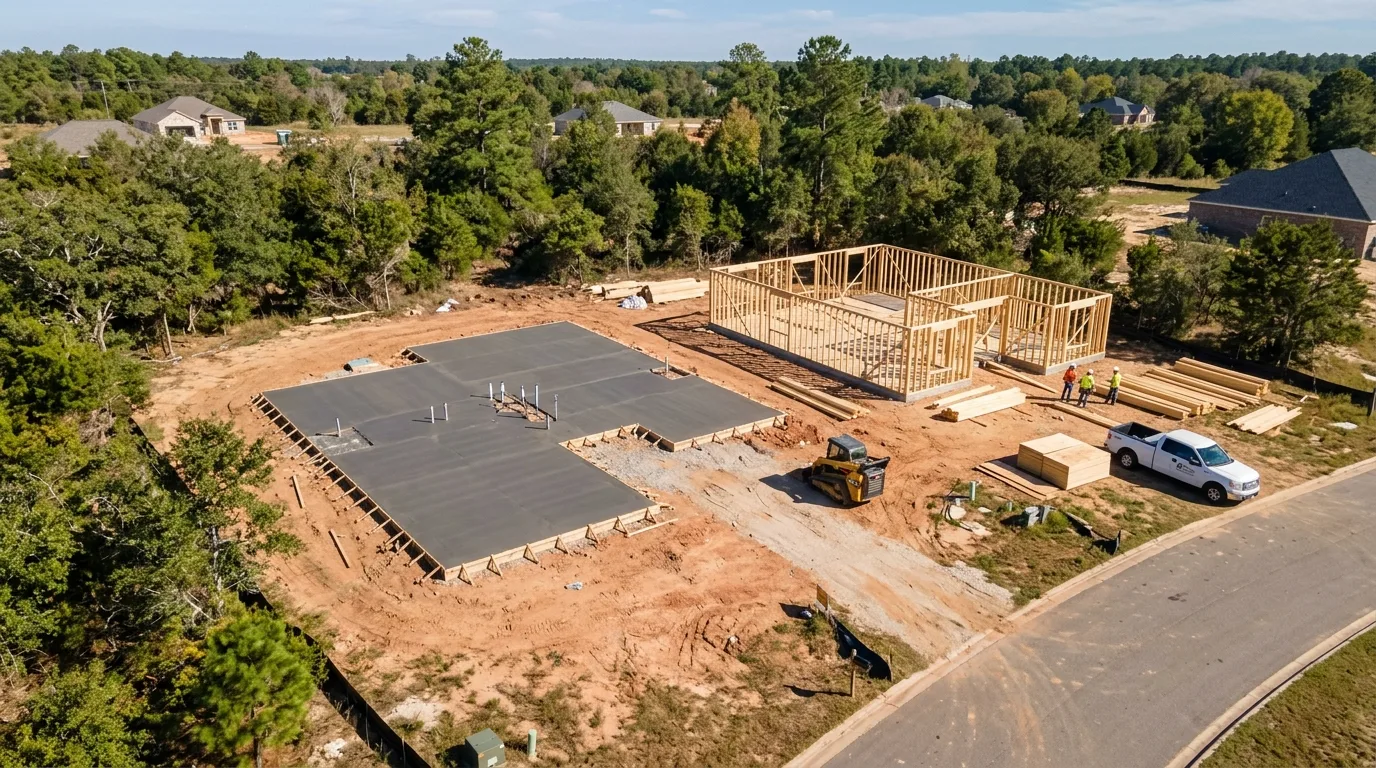
Canyon Lake homeowners planning new concrete driveways, patios, or slabs often hear contractors debate rebar vs. wire mesh. In most stable-soil markets, this is a genuine trade-off — mesh is cheaper, rebar is stronger, and the choice depends on load and budget. In Canyon Lake’s specific geology, it isn’t really a debate. Comal County’s expansive clay soil makes rebar reinforcement the standard practice for concrete that’s expected to last, not an optional upgrade. Here’s why, what spec matters, and what happens when it gets skipped.
Canyon Lake Concrete Built for Hill Country Soil
Every Canyon Lake Concrete Pros project includes the rebar spec appropriate for your site and use case — call (888) 376-0955 for a free estimate.
What Makes Canyon Lake’s Soil Different
The Texas Hill Country sits on what geologists classify as expansive soil — alkaline clay loam underlain by limestone bedrock. This clay has a high plasticity index, meaning it absorbs water from Canyon Lake’s 37.44” of annual precipitation and swells significantly, then contracts as it dries. The vertical movement in Comal County’s clay can reach an inch or more across a wet-to-dry cycle in neighborhoods like Canyon Lake Hills and Ensenada Shores — enough to crack unreinforced concrete from below.
Wire mesh reinforcement is designed to hold together concrete that cracks due to thermal expansion and normal shrinkage during curing. It sits near the bottom of the slab and provides minimal tensile resistance to the upward and differential forces that Canyon Lake’s clay soil generates. When the clay beneath a slab swells unevenly — more moisture under one section than another — it bends the slab across the point of uneven support, and wire mesh doesn’t provide meaningful resistance to this bending force.
Rebar provides the tensile strength to resist bending. A properly placed rebar grid effectively creates a reinforced concrete beam system that distributes uneven soil pressure across the full slab, limiting the deflection that causes cracking.
The Right Rebar Specification for Canyon Lake Concrete
The rebar specification appropriate for any Canyon Lake concrete project depends on slab thickness, load, and soil conditions. Here’s what our crews use as baseline specs:
Residential driveways and patios on standard Canyon Lake clay: #4 rebar (1/2” diameter) on 18” centers, placed at mid-depth of the slab. Combined with a minimum 5” slab thickness and a 4–6” crushed limestone base, this provides adequate resistance to the clay’s seasonal movement.
Garage slabs and residential outbuilding floors: #4 rebar on 18” centers for passenger vehicle loads; #4 or #5 on 12–18” centers for heavier use (shop vehicles, equipment). A vapor barrier is added beneath enclosed slabs to prevent moisture transmission from the clay below.
Heavy-use commercial slabs in Comal County: #5 rebar (5/8” diameter) on 12” centers for vehicle and equipment loads. These thicker mats provide the bending resistance needed for truck approach aprons and loading dock surfaces on canyon Lake’s reactive terrain.
High-activity clay sites: On lots where the clay is particularly active — assessed during site visits through observation of existing concrete condition and soil characteristics — we may specify thickened slab edges (a turned-down perimeter footing) that act as a grade beam to resist edge lifting, a common failure pattern on Canyon Lake’s hillside lots.
How Soil Movement Cracks Concrete Without Rebar
Expansive clay failure in concrete follows a predictable pattern that experienced Canyon Lake contractors recognize immediately. The first sign is corner lifting — the corners of a slab section rise as the clay beneath them swells more than the center of the slab. Without rebar to hold the corners down relative to the body of the slab, the concrete cracks at the change in support.
The second common pattern is center heaving — when the perimeter of the slab loses moisture through evaporation at the edges faster than the center, the center clay swells relative to the drier edges. This creates a dome shape in the slab that, without adequate tensile reinforcement, cracks across the top of the dome. Mesh provides almost no resistance to this bending pattern; rebar does.
In Sattler and Startzville, where many lots are on cut-and-fill terrain with fill material of varying compaction, differential settlement between cut and fill sections is also common. This creates a shear stress across the slab that requires rebar to bridge.
Practical Uses for This Information
- Evaluating quotes: When comparing concrete quotes in Canyon Lake, verify that rebar (not just wire mesh) is specified. Ask the contractor to identify the rebar size and spacing in the written estimate. If a quote uses mesh without explanation of why it’s adequate for your site, ask the question.
- Existing slab assessment: If you have cracked concrete on a Canyon Lake property, the crack pattern can help identify whether rebar was used. Center-to-corner diagonal cracks typically indicate unreinforced concrete on expansive soil. A contractor can assess this during an on-site visit.
- New construction: If you’re building a new home or outbuilding in Comal County, ensure the concrete specification in the contract includes the rebar schedule — not just “reinforced concrete,” which can mean wire mesh.
- POA documentation: For Canyon Lake POA members requiring ACC approval, the rebar specification should be included in the materials documentation submitted for ACC review. Our team prepares this documentation as part of estimate deliverables.
What Happens When Rebar Is Skipped
Concrete poured with wire mesh on Canyon Lake’s expansive clay soil typically develops corner cracking and center cracking within 5–10 years. The timeframe depends on local soil reactivity, drainage around the slab, and whether a limestone base was used. Some sites see cracking in 3–5 years; well-drained sites with less reactive clay may take 10–15 years before significant cracking appears.
The downstream cost of skipping rebar is significant. Surface repair of clay-heave cracks is temporary — the soil continues moving and the cracks reopen. Full slab replacement is the eventual outcome, at a cost of $7–$10/sqft. The cost difference between mesh and rebar at the time of installation is approximately $0.50–$0.75/sqft. On a 600 sq ft driveway, that’s $300–$450 — a fraction of the replacement cost of a failed slab.
Frequently Asked Questions
Is wire mesh ever appropriate for Canyon Lake concrete?
Wire mesh can be used for lightly loaded, small concrete pads in Canyon Lake that are well-drained, protected from direct solar exposure, and on sites with lower clay activity. Equipment pads, small utility slabs, and some interior applications may be candidates. For any slab exposed to vehicle loads or subject to direct soil contact on Comal County’s clay, rebar is the appropriate specification.
How do I know if my lot has particularly active clay?
Observable signs include: existing concrete on the property showing corner lifting or center cracking patterns, trees that have displaced adjacent sidewalks or paths, and cracked brick or block walls around the property. A concrete contractor experienced with Canyon Lake’s soil can assess these signs during a site visit. See also our service page on concrete slab installation in Canyon Lake.
Does the Canyon Lake POA care about rebar specifications?
The Canyon Lake POA’s ACC focuses primarily on exterior appearance and project scope, not construction specifications. However, including the rebar schedule in your ACC documentation demonstrates that the project meets professional standards and can support approval of more complex or larger concrete projects.
Canyon Lake Concrete Slabs Built for Expansive Soil
Canyon Lake Concrete Pros uses the right rebar spec for every project on Comal County's clay. Call (888) 376-0955 for a free site assessment.
Related: